
Our Services
ProfEC Ventus: Your Trusted Partner for Accredited Wind Measurement Architecture. Bankable by Design.
Engineering the complete measurement chain — from system architecture to financial confidence.



ProfEC Ventus GmbH is an internationally recognised, DAkkS-accredited ISO / IEC 17025 Testing and Calibration Laboratory and MEASNET member (ilac-MRA congruent), specialized in bankable assessments for wind energy utilization. We engineer and govern complete wind measurement systems, from structural mast certification and sensor calibration to uncertainty-controlled Energy Yield Assessments, in full alignment with IEC 61400, MEASNET, IECRE and FGW standards. Our work supports project financing, technical due diligence and long-term asset performance.
We provide high-quality, acknowledged, research-based services that govern clients making informed project decisions. We deliver structured, lifecycle-based wind energy services covering accredited measurement architecture, remote sensing governance, advanced CFD wind field modelling, calibration of entire measurement sections, wind resource assessments, bankable energy yield assessments, power performance measurements, due diligences and SCADA based wind farm optimizations during operation. Beyond equipment supply, we design and control the complete measurement and modelling chain, ensuring defensible data, quantified uncertainty and financial-grade reporting for developers, lenders and investors.
Our Services: Accompany across the Full Wind Project Lifecycle
ProfEC Ventus supports wind projects across the full technical lifecycle, from early-stage site analysis and campaign planning through bankable resource assessment and operational performance verification. Our role is not only to provide isolated services, but to engineer and govern the technical chain through which wind data become defensible project decisions and financially credible outcomes.
Preliminary Project Investigations – Seed
Site Optimisation, Spatial Analyses and Site Selection
At the earliest stage of project development, clients require technically credible and decision-relevant insights and databases to determine whether a site justifies further investment and how it should be prioritized against other opportunities. Early-stage intelligence is inevitable to minimize investment risks.
ProfEC supports this phase through Site Optimization and Site Prospection Services that combine spatial analyses by GIS tools, evaluation of meso-scale wind maps, and review of long-term wind data in order to establish an early understanding of project suitability and development potential.
This work includes assessment of infrastructure such as electricity networks, roads, bridges, and ports, as well as geographic site analyses covering terrain complexity, land use, surface roughness lengths and classes, and surrounding obstacles. ProfEC also supports the selection of suitable locations for wind met masts, LiDAR and SoDAR systems, virtual measurement masts linked to mesoscale long-term data, and other measurement station positions, while identifying suitable areas for future wind farm expansion and estimating the likely power density achievable through wind energy deployment.
Where multiple sites are under consideration, ProfEC supports comparative ranking in terms of technical and project suitability and viability. The outcome of this work is a structured basis for further development, including project datasets and files suitable for GIS and industry software workflows such as WASP, WindPRO, and CFD / OpenFOAM, together with a site assessment report and an indicative investment budget plan for subsequent wind resource assessment measurement campaigns.
Wind Mapping and Flow Modelling
Once potentially suitable sites have been identified, the next step is to build a deeper technical understanding of the wind field, respectively the wind resource, itself. ProfEC provides wind mapping and flow modelling services on meso-scale and on micro-scale to interpret how the wind regime behaves across the site and how local conditions may influence future measurement strategy, layout development, and energy yield expectations.
This allows a detailed understanding of how wind behaves across a specific site and how local conditions influence the wind resource. Depending on terrain complexity and project maturity, ProfEC applies micro-scale and CFD modelling to identify terrain-induced speed-up effects, roughness transitions, local sheltering, flow distortion and early wake sensitivities. The results support measurement strategy, layout development and energy yield expectations, providing an important technical bridge between site screening and formal bankable wind resource assessment.
WRF for Meso-scale Wind Mapping
ProfEC Ventus uses WRF mesoscale wind mapping to provide a physics-based view of the regional wind climate, particularly valuable in areas with limited measurement data. Using the Weather Research and Forecasting (WRF) model, ProfEC Ventus simulates atmospheric conditions over extended periods to develop detailed spatial wind maps and long-term wind characteristics. This supports site screening, assessment of regional wind regimes and the identification of areas with promising wind resources before progressing to more detailed site-specific modelling and measurement.
Virtual Measurement Mast Services
Using validated meso-scale modelling and structured correlation methodologies, ProfEC provides Virtual Measurement Mast analyses for early-stage wind resource estimation prior to physical deployment. Based on long-term meso-scale databases, this supports site screening, portfolio prioritization, preliminary feasibility review, and
development risk ranking. Virtual Measurement Mast analysis is not a substitute for physical on-site measurement; it is a disciplined pre-investment tool that reduces early-stage uncertainty and helps direct detailed campaign effort toward the most promising opportunities. Using validated meso-scale modeling and bankable correlation methodologies, we provide early-stage wind resource estimates to help you rank development risks and prioritize portfolios.
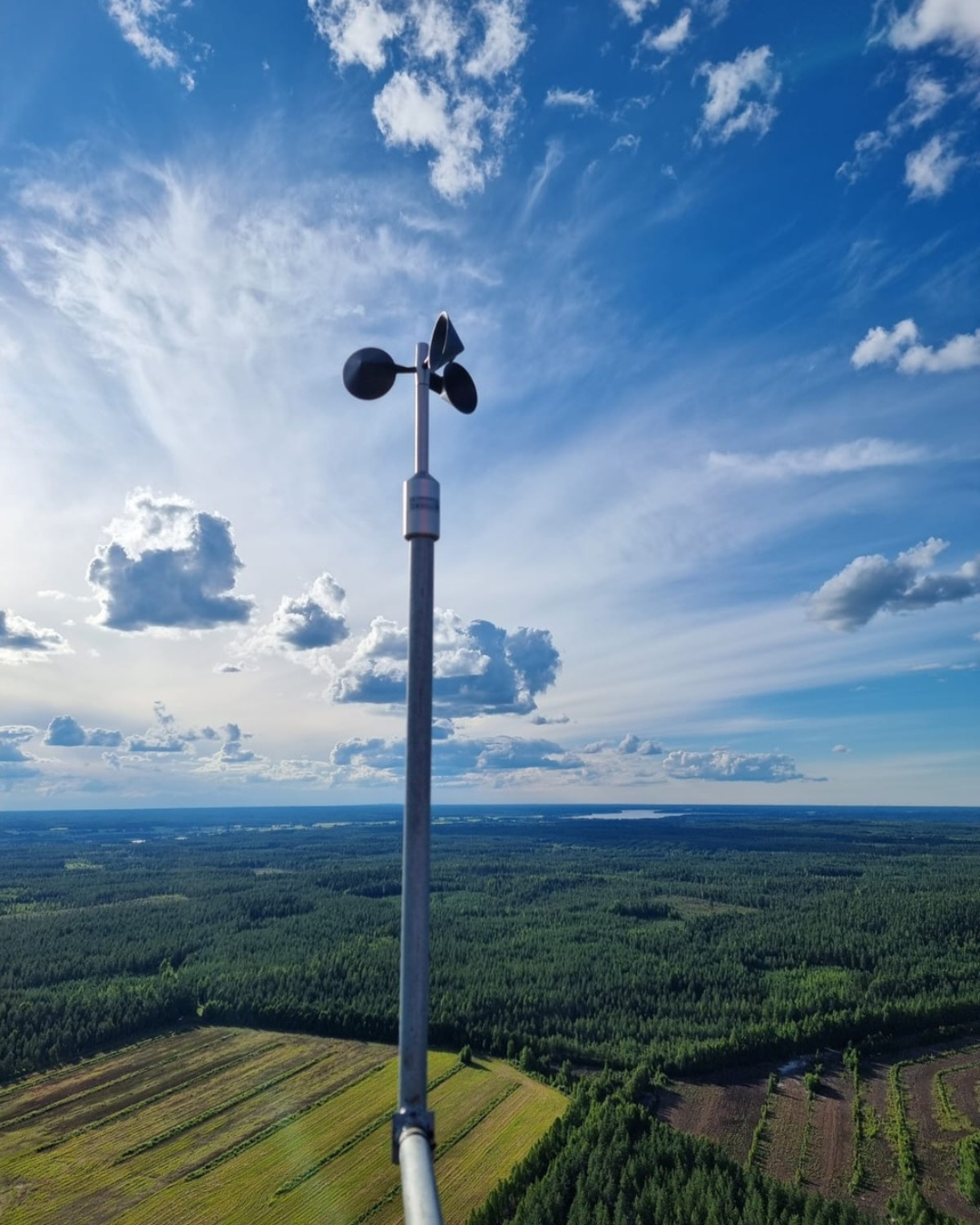
- Spatial Analyses & GIS Databases
- Meso-Scale Wind Maps
- Long-Term Wind Data Processing
- Virtual Measurement Masts
- Evaluation of Infrastructure (Grids, Streets, Bridges, Ports etc.)
- Site Investigations (Terrain, Land Use, Roughness, Obstacles)
- Site Ranking and Selection for Met Mast, RSD and Solar Measurement Stations
- Ranking Suitable Areas for Wind and Solar Project exploration & Yields Assessments
Project Development Phase – Raise
Wind Measurement System Configuration
Once a site enters tangible development, the priority shifts from screening to the controlled execution of a bankable wind measurement campaign. ProfEC designs, assembles, integrates, and governs wind measurement systems as one coherent accredited architecture rather than as a collection of isolated components. This includes bank-compliant mast structural design and certification, multi-vendor sensor integration, surge protection coordination, lightning zoning strategy, grounding philosophy, signal isolation, cable routing logic, logger configuration, firmware governance, signal conditioning, and engineered power supply design for grid-connected, hybrid, or autonomous operation.
By assuming single-point technical responsibility across the full system architecture, ProfEC ensures that measurement design, configuration, and implementation remain methodologically consistent, technically defensible, and fully traceable. Every system is configured under ISO/IEC 17025 traceability and aligned with IEC 61400-50-1 / 50-2, MEASNET, IECRE and FGW TR6 requirements.
Where required, this scope can also include the overhaul, repair, refurbishment and re-calibration of existing campaign hardware, in order to restore it to a controlled and bankable configuration standard before redeployment.
RSD Devices (LiDAR and SoDAR) Measurements, Classification and Verification
Remote sensing becomes bankable only when deployment methodology is technically defensible and properly verified. ProfEC provides accredited governance of LiDAR and SoDAR systems, including RSD classification for pre-construction campaigns, hybrid mast–RSD strategies, campaign extension programs, and multi-device deployment concepts. Our scope includes verification against in-situ reference masts, IEC 61400-50-2 aligned validation, bank-compliant, proven and evidential correlation methodology, flow complexity evaluation, campaign defensibility review, and structured gap-filling or extension logic. We do not simply deploy devices; we govern the defensibility of the measurement campaign in which they operate.
Accredited Calibration of Sensors
As one of the few laboratories accredited under ISO/IEC 17025 and MEASNET for wind tunnel calibration of wind sensors, ProfEC provides fully traceable calibration of cup and ultrasonic anemometers, wind vanes, barometric pressure sensors, temperature and humidity sensors, and data loggers. Calibration bias directly affects wind resource interpretation, Energy Yield Assessment, and probability-based financial outputs. Accurate, traceable calibration reduces systematic measurement error at source and strengthens the statistical foundation on which financing decisions are made.
Installation, Commissioning and Certificate of Bankability
ProfEC supports installation and commissioning within an accredited framework, ensuring that the complete measurement chain remains governed and traceably monitored from field deployment through final technical acceptance. This includes bankable certification of mast design, installation conformity checks, structured commissioning workflows, calibration traceability control, configuration governance, and final documentation under controlled quality procedures.
ProfEC issues bankable installation and commissioning reports for mast- and RSD-based measurement systems, providing a traceable technical record of conformity, configuration, and commissioning status within the accredited framework. This framework can also support a formal statement on the integrity and authenticity of measurement data, confirming that acquisition, configuration, and handling logic remain governed and traceable within the controlled measurement chain.
Where ProfEC is responsible for key elements of system integration, including data logger programming, sensor cabling, remote data retrieval periphery, and sensor calibration, this process may culminate in the Certificate of Bankability. Issued within an ilac-MRA recognised accredited framework, the certificate is aligned with IEC 61400-12-1, IEC 61400-50-1, IEC 61400-50-2, MEASNET procedures, and / or FGW TR6 requirements, and provides a formal bankability statement for the configured measurement system. In this way, engineered measurement architecture is translated into investor-facing technical assurance.
Measurement quality is not maintained by hardware alone, but through disciplined operational control throughout the campaign lifecycle. ProfEC provides remote monitoring of wind measurement campaigns through structured data retrieval, availability supervision, uptime governance, anomaly detection, and controlled follow-up of campaign status and data quality.
Reporting can be structured on a daily, weekly, or monthly basis according to project requirements. Governed by quality assurance banking on ISO 9001 and ISO 17025, remote monitoring also covers the status of stations energy supply, site access events, and relevant operational activities, while structured logbook and event history tracking are maintained for maintenance actions, alarms, interventions, and other campaign-relevant incidents. Our approach includes defined quality-controlled filtering, watchdog and alert functions, supervised access to live or historical campaign data where required, and active oversight of continuity and reporting quality. Data integrity and authenticity is actively governed, not passively assumed.
CCC – Custom Code Creator and Data Integrity Governance
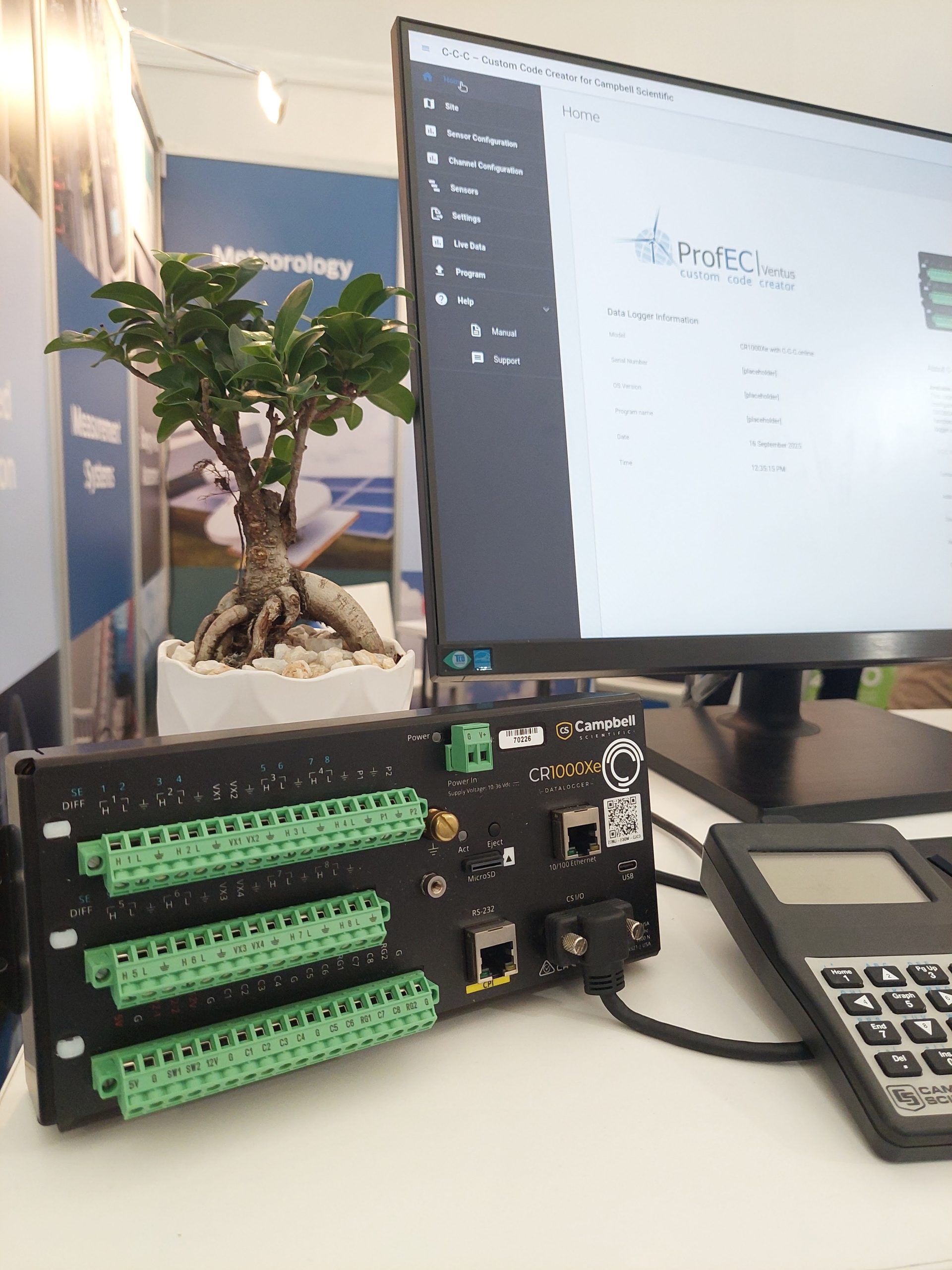
Verified, transparent and traceable logger programming and disciplined data acquisition logic warranting data authenticity and integrity are essential to any trustworthy wind or solar measurement campaign. ProfEC’s C-C-C: Custom Code Creator supports the structured configuration and automated code generation of Campbell Scientific data loggers, enabling consistent and transparent integration of sensors, measurement channels, acquisition logic, and transmission settings across complex campaign architectures.
By reducing dependence on manual coding or expert programming skills and by offering a user-friendly web browser-based configuration environment, C-C-C strengthens consistency, reproducibility, and traceability throughout the measurement chain. This is particularly important in multi-sensor and multi-device systems where data integrity, authenticity, and secure transmission must remain controlled from acquisition through reporting: the code generated by C-C-C and deployed on the Campbell Scientific data logger is entirely transparent and completely displayed to the user. No hidden secrets, no black box involved. The client can feel free to use all, or only parts of the generated code, as well as to alter it further in accordance to his needs and wishes.
C-C-C is designed to support high standards of data quality and secure handling in line with the technical expectations of IEC, FGW TR6, and MEASNET-aligned evaluation practice. In this way, it contributes not only to operational efficiency and user friendliness, but to the broader bankability and defensibility of campaign data. C-C-C therefore forms a technical bridge between logger configuration, controlled data acquisition, and finance-grade measurement defensibility. C-C-C is flexibly configurable in several aspects: customization by your Corporate ID or adding new sensors and functions never was so easy.
Got excited about ProfEC’s Custom Code Creator? Please feel free to join our webinar or ask for a personal introduction session bringing you closer the strengths, advantages and ease of using C-C-C.
Site Classification, Turbulence Intensity and Extreme Wind Analyses
Before a project advances into detailed design, site conditions must be understood not only in terms of yield potential but also in terms of turbine suitability and structural loading environment. ProfEC performs site classification, turbulence intensity assessment, and extreme wind analyses to support turbine class suitability, technical risk evaluation, and the foundation of later layout, financing, and operational decisions. These studies are particularly important in complex terrain, high-wind environments, and locations where local flow behaviour has direct implications for project bankability. The results provide a bankable technical basis for turbine suitability assessment, layout refinement, and later project reporting.
Wind Resource Assessments and Energy Yield Assessments
ProfEC performs bankable, accredited Wind Resource Assessments and Energy Yield Assessments using methodologies proportionate to site complexity and financing relevance. This includes long-term correlation, reference dataset validation, meso-scale integration, micro-scale CFD where required, shear and veer treatment, turbulence validation, and residual bias control in order to convert campaign data into a defensible site-specific understanding of the wind regime.
Building on this foundation, ProfEC delivers bankable Energy Yield Assessments with probability-based outcomes such as P50, P75, P90, P95 and P99. Each assessment includes validation of the measurement campaign, review of vertical extrapolation methodology, flow modelling defensibility, wake loss evaluation, technical loss modelling, grid constraint integration, and scenario sensitivity testing. Reports are prepared in alignment with IEC, MEASNET, FGW TR6, and international lender technical advisor expectations, with the objective of delivering structured statistical confidence for sound financial decision-making.
Uncertainty Assessments of Wind Resource and Energy Yield
Uncertainty is quantified, separated, and statistically combined in accordance with international best practice. ProfEC evaluates measurement uncertainty, modelling uncertainty, long-term correction uncertainty, loss modelling variability, operational availability effects, inter-annual variability, and the integrity of probability treatment assumptions. This service is central to project bankability because financing quality depends not only on expected production, but on the transparency and robustness of the uncertainty framework behind the reported P-levels. Reports are prepared in alignment with IEC, MEASNET, FGW TR6, and international lender technical advisor expectations, with the objective of delivering structured statistical confidence for sound financial decision-making.
Loss
Loss Assessment and Yield Optimisation Recommendations
Loss assessment should remain visible as a distinct service because it plays a material role in both pre-financial modelling and later operational interpretation. ProfEC assesses wake losses, availability effects, electrical losses, environmental constraints, curtailment factors, grid limitations, and other technical deductions that influence net energy yield. This work supports both development-phase Energy Yield Assessments and later project optimisation by ensuring that net production assumptions remain technically credible and commercially realistic.
- RSD-devices (LiDAR / SoDAR) Measurements, Verifications and Classifications
- Accredited Calibration of Sensors, Overhaul, Repair and Refurbishments
- Wind or Solar Resource Measurement Stations incl. Certificate of Bankability
- Accredited Measurements & Data Governance
- Bankable Certification of Mast Design, Installation and Commissioning
- Energy Yield Assessment (bankable, accredited Energy Prognoses)
- Accredited Uncertainty Assessments & Probability Levels
- Site Classification and Turbulence Assessments
Project Operational Phase - Harvest
Site Calibration
Once a project enters operation, measurement and modelling move from development support into performance verification and operational assurance. ProfEC performs site calibration in accordance with IEC 61400-12-1, using accredited methodologies and controlled reference system design. This supports reliable interpretation of turbine performance under site-specific inflow conditions and provides the technical basis for subsequent verification and optimisation work.
Power Curve Verification and Power Performance Measurements
ProfEC provides Power Curve Verification Tests (PCVT) and Power Performance Measurements (PPM) to assess whether turbines are performing in line with expected behavior under real site conditions. This includes reference mast design and deployment where required, nacelle-based testing support, benchmarking of turbine performance, and preparation of independent verification reports. These services support contractual validation, structured OEM interface discussions, refinancing cases, and operational reassessment.
Technical Due Diligence
ProfEC provides independent technical due diligence for operating assets, covering measurement campaign architecture, data integrity, modelling defensibility, uncertainty treatment, and compliance with applicable standards. These studies provide structured
technical risk transparency for investors, lenders, insurers, and asset owners involved in acquisitions, refinancing, disputes, or ongoing asset evaluation.
The purpose of this service is to establish an independent technical view of whether the asset, its supporting data, and its performance assumptions remain methodologically sound, defensible, and suitable for financial decision-making.
Energy Yield Optimization
Operating projects require continued evaluation of performance relative to forecast and design expectation. ProfEC supports this through energy due diligence and the structured identification of yield optimization opportunities. This includes analysis of wake behavior, yaw alignment, availability patterns, operational constraints, curtailment effects, and other performance-relevant mechanisms that influence long-term yield.
The result of this service is not only to diagnose performance gaps, but to identify technically grounded measures that can improve long-term project output and commercial performance.
Project and Portfolio Analyses and Due Diligence
For clients managing multiple operating assets, ProfEC supports project-level and portfolio-level analyses to identify inconsistencies across sites, compare yield robustness, quantify technical risk concentration, and support strategic decisions across broader operating fleets. This is particularly relevant where transactions, refinancing, or portfolio optimization require a consistent technical review basis across multiple projects.
By extending analysis from the single asset to the wider fleet, ProfEC helps clients understand where technical, energy, or operational patterns are isolated and where they represent portfolio-level themes requiring strategic response.
ProfEC’s Due Diligence services yield in structured transparency for investors, lenders, insurers, and asset owners involved in acquisitions, refinancing, disputes, or ongoing asset evaluation.
Nacelle LiDAR for Energy Optimization and PCVT
Where suitable, nacelle LiDAR can be employed during the operational phase to support power performance testing, inflow characterization, wake analysis, and optimization-related studies. This service reflects ProfEC’s ability to move beyond development-stage measurement into technically controlled support for operating asset performance verification and improvement.
SCADA-Based Diagnostics and Analytics
ProfEC supports operational assessment through SCADA-based diagnostics and analytics, enabling identification of underperformance trends, operational anomalies, loss patterns, and optimisation opportunities based on live or historical plant data. This service extends ProfEC’s role from measurement governance into operating-asset intelligence, helping clients interpret site behavior through traceable technical evidence rather than fragmented observation.

- Optimized Wind Project Operations
- Site Calibration
- Wind Turbine Power Curve Verification and Testing (PCVT)
- Wind Turbine Power Performance Measurements (PPM)
- Nacelle LiDAR employment for energetic optimization and PCVT
- Optimization of Energy Yields During Project Operation
- SCADA Diagnostic and Analytics
- Project Due Diligence
- Portfolio Analyses